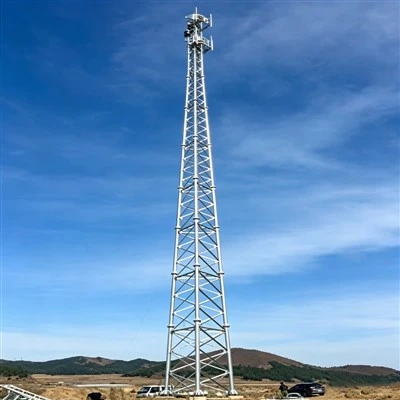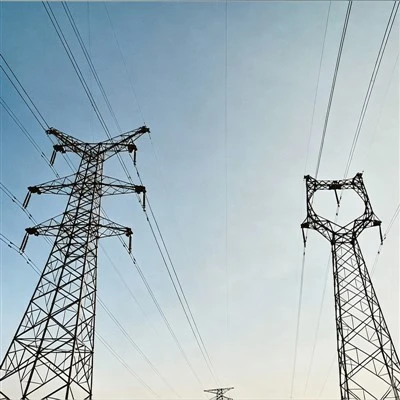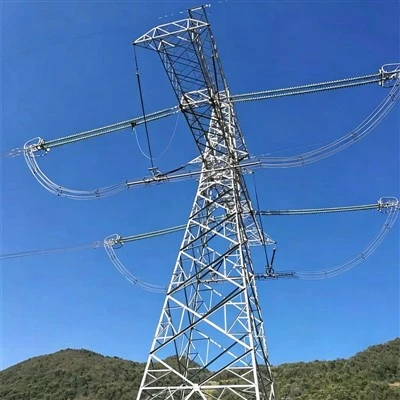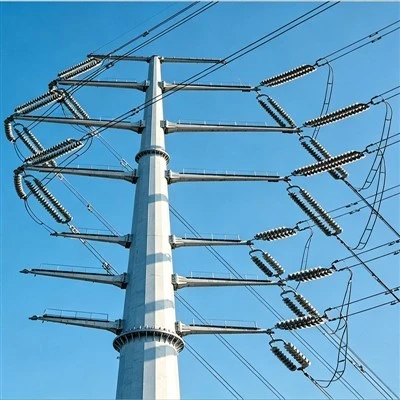

The main structure utilizes national standard carbon steel angle sections (such as Q235B/Q345B), with auxiliary members ranging from 40×4 to 75×8; hole positioning accuracy of ±0.5mm is ensured through automated assembly-line punching.
Hot-dip galvanized surface treatment (zinc coating thickness ≥86μm) provides long-lasting corrosion protection, with a service life exceeding 30 years under salt spray test conditions.
Materials: Primary and secondary components are predominantly made of carbon or low-alloy structural steels such as Q235 and Q345 (now corresponding to Q355).
Anti-corrosion: The entire surface undergoes hot-dip galvanizing; the zinc coating thickness is typically ≥85 μm, and the design service life exceeds 30 years.
Structural Form: It utilizes a space truss system where members primarily bear axial loads; classified by function into tangent towers, tension towers, and angle towers, and by shape into "wine-glass," "cat-head," and "Gan-shaped" (inverted-T) configurations.
Auxiliary Facilities: For towers under 60 meters in height, climbing steps are usually installed on the main members to facilitate maintenance access; the tower top is equipped with overhead ground wire supports and interfaces for communication platforms.